
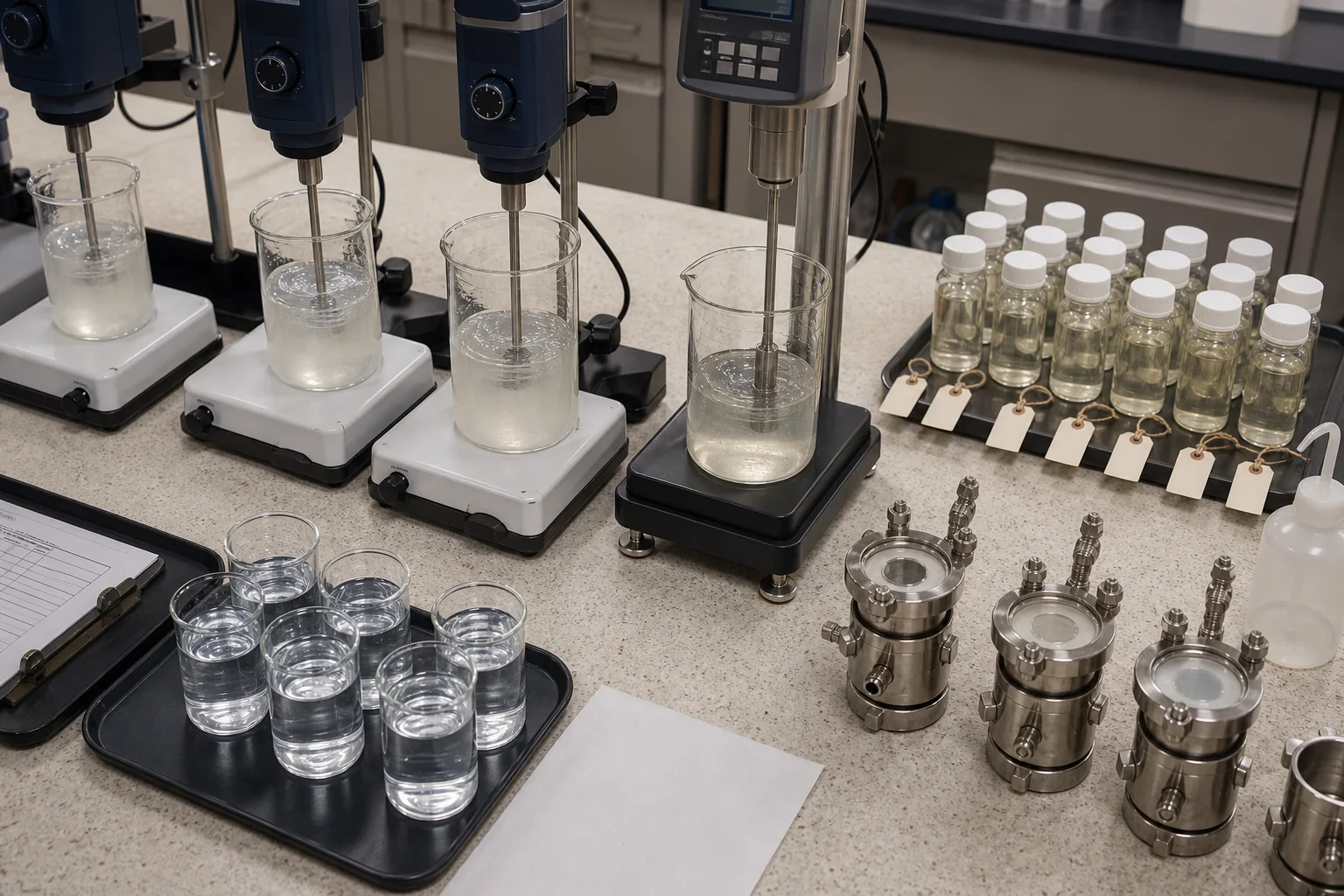
Replace the salt-resistant label with water evidence
High salinity is not a complete water specification. Provide major ion analysis, hardness, pH, iron, temperature and realistic source-water blends. Two waters with similar total dissolved solids can interact differently with a proposed polymer, so a catalogue salinity limit is not sufficient to approve a shipment.
Ask the supplier which polymer chemistry is proposed and which condition limits its use. Conventional HPAM and specialized copolymer proposals should be compared as identified candidates, not treated as interchangeable names. Confirm availability and documents for the offered code before assigning it a place in routine procurement.
Test at the intended concentration and exposure
Prepare candidates with the actual treatment sequence and relevant brine. Record hydration or inversion, concentration, elapsed time and test temperature. Include the incumbent and a controlled reference where available so poor make-down is not mistaken for an intrinsic salt response.
Compare viscosity at a common method and inspect clarity, deposits and filter behavior. Then assess the longer exposure specified by the project under controlled conditions. A strong initial result in a simplified sodium-chloride solution does not demonstrate stability in a hard produced-water blend.
Require the whole qualification window
Thermal exposure, oxygen conditions, mechanical shear and reservoir interaction remain relevant even when a formulation is described as salt tolerant. Evaluate the combination expected in service rather than collecting independent best-case certificates. A proposed improvement in one property may not remove the need for filtration or injectivity work.
Record conditional passes explicitly. A candidate that works only with a particular water blend or pretreatment must be assessed against the plant's ability to maintain that condition. Do not quietly move water-treatment or equipment expenditure outside the polymer offer to make its price appear more competitive.
Ask for a bounded commercial response
The purchase brief should state the tested brines, relevant temperatures, preparation limits and evidence still required before field use. Request coded samples, current documents and a technical explanation for the shortlist. Avoid an unrestricted order for a generic high-temperature high-salinity grade before the actual product has been qualified.
Link the accepted code to the measured envelope and receiving checks. Require review after water-source, treatment or formulation changes that leave that envelope. No salt-tolerance label removes the operator's responsibility for reservoir qualification or establishes a universal operating temperature.
Related qualification and order decisions
Keep the corresponding operating test record with the purchase evidence. Further checks include HPAM for Produced-Water-Blend Injection: What to Confirm Before Ordering and EOR Polymer Thermal-Stability Bids: Request Comparable Aging Evidence.
Request a coded sample or a bounded trial quotation through the oilfield polymer operating brief. Include the duty, actual water or formulation, preparation limits, acceptance method, quantity and destination; distinguish demonstrated results from conditions still awaiting qualification.