
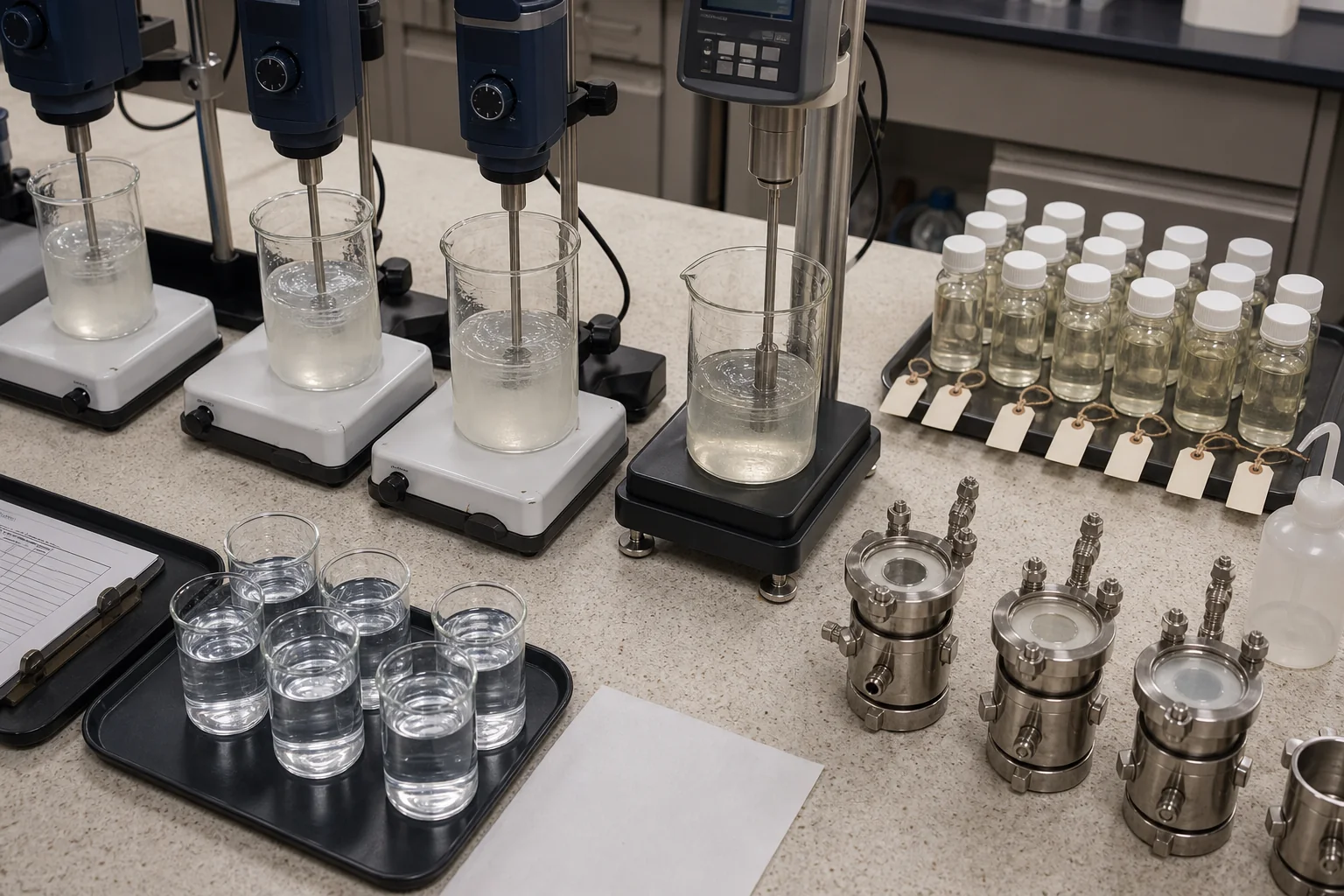
Specify the measurement basis
State polymer concentration, preparation water, temperature, instrument, geometry and shear rate for every value.
Viscosity numbers without conditions are not comparable.
Build the brine matrix
Test normal injection water and credible changes in TDS, calcium, magnesium and source-water blending.
Record haze, precipitate and dissolution together with viscosity.
Control oxygen and contamination
Use the project's oxygen-control and biocide assumptions during aging where relevant.
Oxidative or biological degradation can be confused with thermal instability.
Age at relevant temperature
Measure initial and aged samples at agreed intervals and preserve sealed controls.
Avoid extrapolating long-term reservoir behavior from one short ambient reading.
Use the correct shear rate
Polymer solutions are non-Newtonian, so viscosity changes with test shear.
Select a method connected to project modeling or operating comparison and use it consistently.
Apply mechanical shear
Pass the solution through a defined device or field-representative restriction and measure retained viscosity.
Report energy or pressure conditions so another team can reproduce the comparison.
Check filterability
Inspect dissolution and filtration alongside viscosity because gels or debris can affect injection.
The most viscous candidate is not acceptable if cleanliness falls outside the project criterion.
Report a performance envelope
Summarize retained viscosity across water, temperature, aging and shear conditions with sample identity.
Use the envelope for candidate selection without claiming behavior beyond the tested window.
Field interpretation and decision record
Report viscosity retention as a controlled comparison, not as an isolated high number. The test record should identify polymer concentration on the same basis, brine preparation, ion analysis, pH, dissolution sequence, aging time, test temperature, instrument, geometry and shear history. Include the initial value and timed values after conditioning. Without this context, two viscosity figures from different laboratories are not commercially or technically comparable.
Water chemistry should be reproduced deliberately. Total dissolved solids alone does not describe the effect of divalent ions, alkalinity or iron. Prepare the expected injection water and any credible upset water, then keep the blank and reference polymer in the same batch. If produced-water blending is planned, include the actual blend range and observe precipitation, haze or filter response before interpreting viscosity. A polymer that retains viscosity but creates unacceptable filterability is not automatically suitable for injection.
Temperature exposure needs a defined sequence. Distinguish make-down temperature, surface holding temperature and the temperature used for accelerated or reservoir-relevant conditioning. Prevent evaporation and oxygen differences from becoming hidden test variables. When chemical stability matters, record the atmosphere and any oxygen-control procedure rather than implying that temperature alone explains the result. Compare samples at matched elapsed time because polymer hydration and degradation can move in opposite directions during early conditioning.
Shear should be measured across the actual equipment path. Take samples before and after pumps, restrictions or filters when possible, and reproduce that energy in the laboratory only after documenting the method. A single high-speed mixer test may rank severe mechanical sensitivity but may not represent the field. Track retained viscosity, filterability and injection behavior together. The decision should state the acceptable retention window, the water and temperature limits, and which equipment changes would require the candidate to be tested again.