
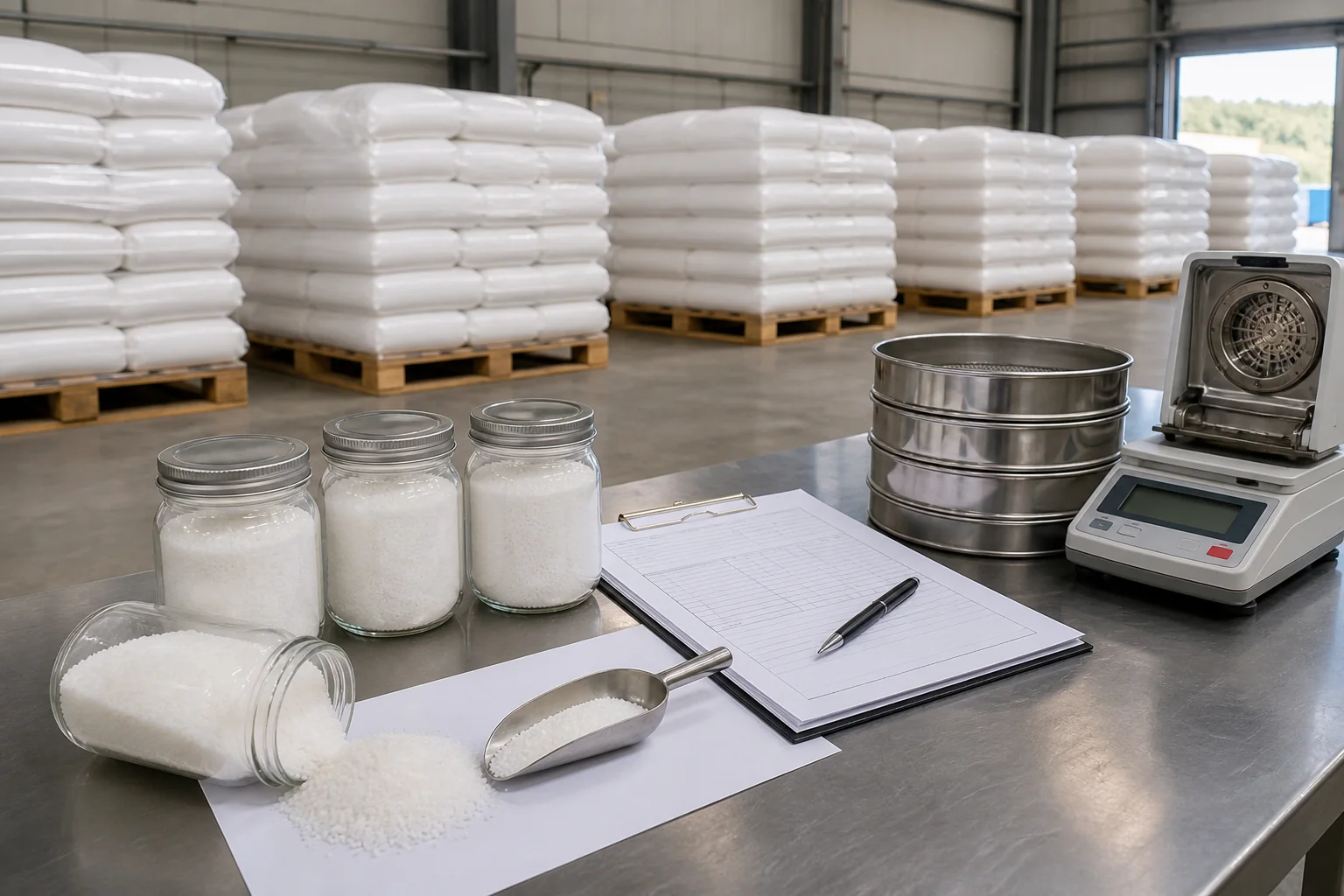
Connect the delivery to the accepted material
Compare production code, lot, package markings, net mass and documents with the accepted sample and purchase order. Preserve any written relationship between a laboratory code and the commercial identity. A familiar chemical name or similar molecular-weight range is not enough to release an unverified substitution.
Record packaging damage, moisture exposure or other arrival concerns using the plant's receiving procedure. Physical inspection can identify handling issues but does not prove application performance. Obtain current product documents and code-specific storage guidance before placing the material into the operating stock position.
Use a duty-specific reference comparison
For EOR, reproduce the agreed water, preparation, viscosity and filtration checks; for PHPA, use the relevant whole-mud procedure; for produced water, use the actual separation screen. Do not apply one convenient freshwater viscosity test to all three applications and describe the shipment as universally accepted.
Test delivery and retained reference on the same current water or formulation with comparable solution age and calibration. A difference from a result recorded months earlier may reflect changed feed rather than changed polymer. Preserve raw records and repeat points before assigning a cause.
Investigate preparation before blaming a lot
Check concentration basis, water, wetting or activation, time, contamination and delivery hardware when performance changes. Keep sample and prepared-solution labels unambiguous. A new shipment arriving at the same time as a water-source or equipment change creates competing explanations, not proof of a product defect.
If the reference comparison still differs materially, escalate with paired results, lot documents, storage history and the process record. Follow the authorized hold-and-release procedure rather than mixing uncertain material into approved stock or relying on an undocumented extra chemical setting.
Release a bounded production identity
Record who accepts the shipment, which criteria passed and whether additional monitored field confirmation is needed. Retain representative material where practical under suitable conditions for an agreed period. Keep first-lot acceptance linked to the original qualification limits rather than creating a new specification after delivery.
Use consistent receiving records for subsequent lots at a frequency appropriate to the operation. Proposed product or manufacturing changes require the agreed review. This gives purchasing a repeatable identity and performance check without implying that a COA alone guarantees reservoir, well or water-treatment outcomes.
Related qualification and order decisions
Keep the corresponding operating test record with the purchase evidence. Further checks include Oilfield Polymer Equivalent Offers: Verify the Replacement Instead of the Label and Bulk Oilfield PAM Supply: Plan Remote Delivery, Storage and Lot Continuity.
Request a coded sample or a bounded trial quotation through the oilfield polymer operating brief. Include the duty, actual water or formulation, preparation limits, acceptance method, quantity and destination; distinguish demonstrated results from conditions still awaiting qualification.