
Separate the three main duties
Polymer flooding seeks controlled solution viscosity and injectivity; drilling-fluid PHPA supports a complete mud formulation; produced-water treatment seeks measurable oil and solids separation.
These duties use different tests and acceptance criteria. A grade suitable for one should not be transferred by product name alone.
Describe water and temperature
Provide source-water ions, TDS, hardness, pH, iron, temperature and oxygen-control conditions relevant to preparation and use.
Use actual water in screening. Published freshwater values cannot establish brine or field performance.
Define molecular and ionic screening
Molecular weight, hydrolysis, charge and copolymer chemistry affect viscosity, adsorption, flocculation and salt response.
Ask for a bounded candidate set, then measure the response required by the application rather than selecting the highest specification value.
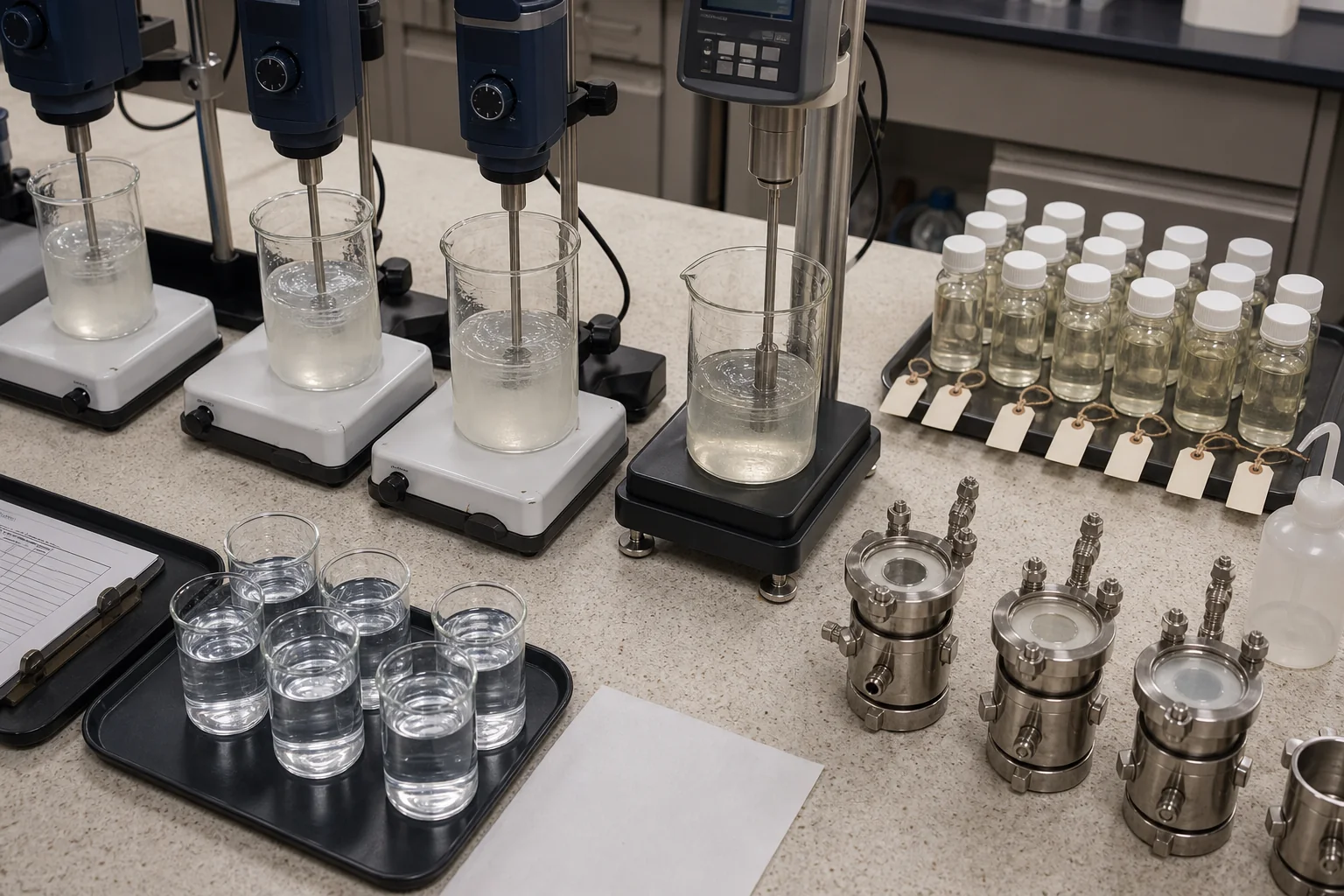
Reproduce preparation
Record powder wetting, concentration, mixing, aging, dilution and filtration. Compare candidates at the same active basis and solution age.
Undissolved material or mechanical degradation can hide the real product ranking.
Challenge the field route
Apply representative shear, temperature, residence and contamination. Include pumps, restrictions and downstream equipment in the scale-up plan.
A quiet beaker result is only the first screen.
Use a decision table
Place candidate identity, conditions, dose or concentration, test outcomes and failure observations in one table.
Advance products that meet the complete acceptance window, not one preferred number.
Confirm supply and compliance
Link the approved sample to COA, SDS, packaging, lot and quotation. State local chemical, well, discharge or waste requirements separately.
Do not infer certifications or regulatory approval from technical performance.
Set requalification triggers
Recheck after water-source, reservoir, mud-formulation, separator, product or manufacturing changes that could move performance.
A retained reference and full baseline record make requalification faster and more defensible.
Field interpretation and decision record
A useful selection record begins with a one-sentence duty statement. For polymer flooding, that statement should name the target injection viscosity, reservoir or surface temperature, injection-water chemistry and the equipment path. For drilling fluid, it should name the intended PHPA function and the complete mud system. For produced water, it should identify the separation stage and the water-quality result. This prevents three unrelated uses of polyacrylamide from being collapsed into one generic product request.
Build a candidate matrix before asking for price. Record product form, ionic profile where relevant, molecular profile, active basis, preparation method, water source, test temperature and conditioning time. Add one incumbent or approved reference and one blank. A result without these controls cannot show whether the observed change came from polymer chemistry, concentration, make-down or normal sample variability. Keep visual observations, but connect them to the measurement that governs the operating decision.
The scale-up review should follow the polymer from bag opening to the point where performance is measured. Note hopper wetting, stock concentration, aging time, dilution water, transfer pump, valves, filters and residence time. A candidate that performs only after unusually gentle laboratory handling may fail in the actual system. Conversely, poor preparation can make a suitable polymer look weak. Separate product rejection from preparation failure by checking solution uniformity and repeating the reference under the same procedure.
Procurement should preserve the tested identity. Link the approved sample code to the quotation, COA and SDS, packaging, storage conditions and receiving check. State the field acceptance method and the operating window used during approval. Do not convert a successful bench result into a universal dosage promise. The defensible outcome is a bounded recommendation: this candidate met these measurements in this water, at this temperature, after this preparation, and still requires controlled field confirmation.