
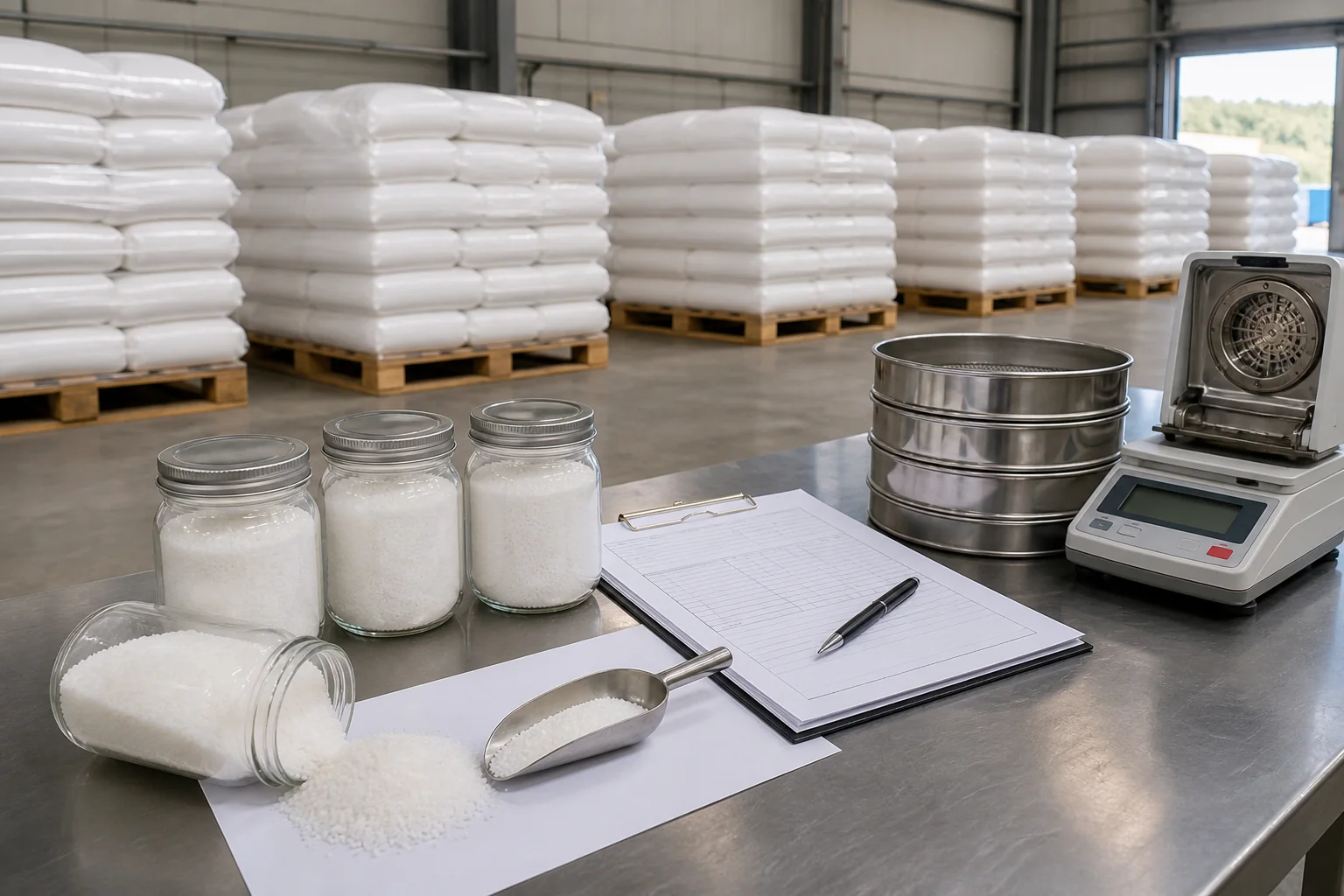
Separate laboratory samples from field material
An oilfield polymer pilot order should identify the duty, candidate count, test sequence and the evidence required for progression. Polymer-flood solution volume, drilling-fluid batch requirements and produced-water treatment consumption are not interchangeable calculations. Name the relevant unit basis before asking for a package count.
Confirm preparation instructions and documented active content or assay basis for each code. State what part of the plan remains uncertain, such as water availability or operating duration. An oversized first shipment can create storage exposure without solving an inadequately planned qualification trial.
Calculate productive consumption transparently
For an EOR solution, required supplied mass is treated volume × active concentration ÷ confirmed active fraction, with compatible units. As arithmetic illustration only, 100 cubic metres at one kilogram active per cubic metre and a fraction of 0.8 require 125 kilograms of supplied product.
Those inputs are not a recommended injection concentration or assay. For another duty, use its approved dose or mud concentration and measurement basis instead. Do not substitute a neat-product volume for mass without the necessary density and concentration information.
Add justified nonproductive allowances
Account separately for preparation-unit filling, pipe and tank hold-up, transition material, retained samples and repeated points. Confirm these quantities with the installed system and technical team. Too little material can force sampling during mixed-product transitions and invalidate a trial despite an apparently adequate total runtime.
Plan interruption and difficult-water allowances from credible conditions rather than adding an unexplained safety multiple. Include package increments and protected storage constraints. If the pilot cannot cover an important operating window, identify a staged follow-up quantity instead of treating the initial shipment as complete qualification.
Release dispatch against readiness and identity
Match each package to the sample code, production lot, preparation instructions and quotation. Confirm equipment, water, operators, measurements and delivery access before shipment. Keep chemical delivery separate from technical services unless those services have been explicitly agreed and priced.
After the pilot, reconcile supplied usage with valid treated volume and the accepted result. Preserve transition and interrupted periods rather than blending them into a favorable average. The purchase record should show why routine supply is justified or which additional bounded test is still needed.
Related qualification and order decisions
Keep the corresponding operating test record with the purchase evidence. Further checks include Oilfield PAM First-Lot Acceptance: Reproduce the Approved Application Test and Bulk Oilfield PAM Supply: Plan Remote Delivery, Storage and Lot Continuity.
Request a coded sample or a bounded trial quotation through the oilfield polymer operating brief. Include the duty, actual water or formulation, preparation limits, acceptance method, quantity and destination; distinguish demonstrated results from conditions still awaiting qualification.