
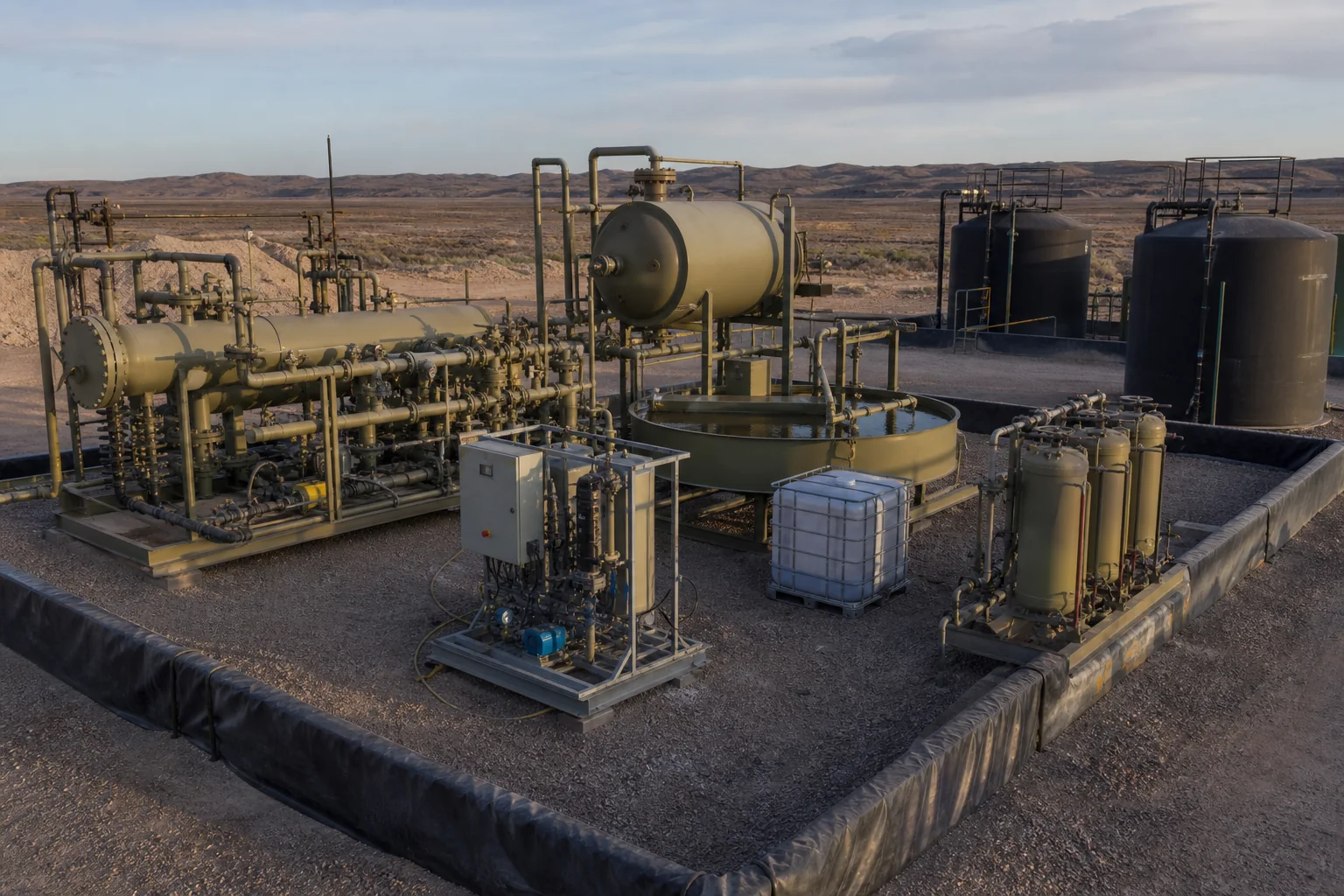
Collect at the correct point
Sample after the upstream separation and chemistry that will remain in service.
Record oil, solids, salinity, pH, temperature and well mix.
Preserve temperature and time
Run promptly and maintain a representative temperature when oil behavior depends on it.
Document cooling and storage that cannot be avoided.
Reproduce chemical sequence
Add demulsifier, coagulant, pH treatment and polymer in the actual order.
Use identical mixing and residence across candidates.
Screen on active dose
Compare plausible polymer profiles at equal active mass with blank and incumbent controls.
Do not rank by neat product volume.
Simulate the separator
Use flotation, settling or filtration conditions connected to the plant step.
Apply shear before separation when pumps occur after injection.
Measure oil and solids
Use site methods for residual oil, suspended solids, turbidity or filter performance.
Photographs support but do not replace measurements.
Inspect float and sludge
Record volume, stability, skimming, dewatering and downstream filter effect.
Avoid transferring the problem from water to waste handling.
Confirm on live equipment
Run controlled points and allow carryover to clear before sampling.
Approve a bounded range tied to the actual water window.
Field interpretation and decision record
Preserve the produced-water sample so the test represents the process question. Record sampling point, time, temperature, oil and solids condition, upstream chemicals and any settling during transport. Mix the bulk sample consistently before splitting test portions. If the objective concerns flotation, clarification, filter pretreatment or sludge handling, state that objective in advance because the preferred floc size and strength can differ for each separation step.
Build a screening sequence with a blank, current treatment and coded candidates at equal active-dose steps. Reproduce coagulant or demulsifier order, mixing intensity, contact time and separation time. Observe floc formation and breakage, but measure the water result that governs the decision, such as turbidity, suspended solids, oil response or filter behavior. Record float or sludge volume and stability because an apparently clean water phase may create an impractical waste-handling burden.
Process compatibility matters. Produced water can contain salinity, hardness, dispersed oil, corrosion products and residual chemicals that change polymer response. Test the representative range rather than substituting clean water. Follow the candidate through pumps and the intended separator where feasible. Check whether fragile floc is destroyed before flotation or whether overdosing causes carryover and downstream filter pressure. A larger visible floc is not a sufficient acceptance criterion.
The field trial should use a bounded dose ladder, stable baseline and predefined sampling locations. Hold flow and major upstream conditions as steady as operations allow, and record deviations. Compare treated-water, recovered-oil and waste-stream consequences together. Final discharge, reuse and waste requirements belong to the operator and applicable authorities; product screening does not establish compliance. Preserve the approved sample identity, preparation method and trial data so a quotation and later receiving check refer to the material that actually met the defined process targets.